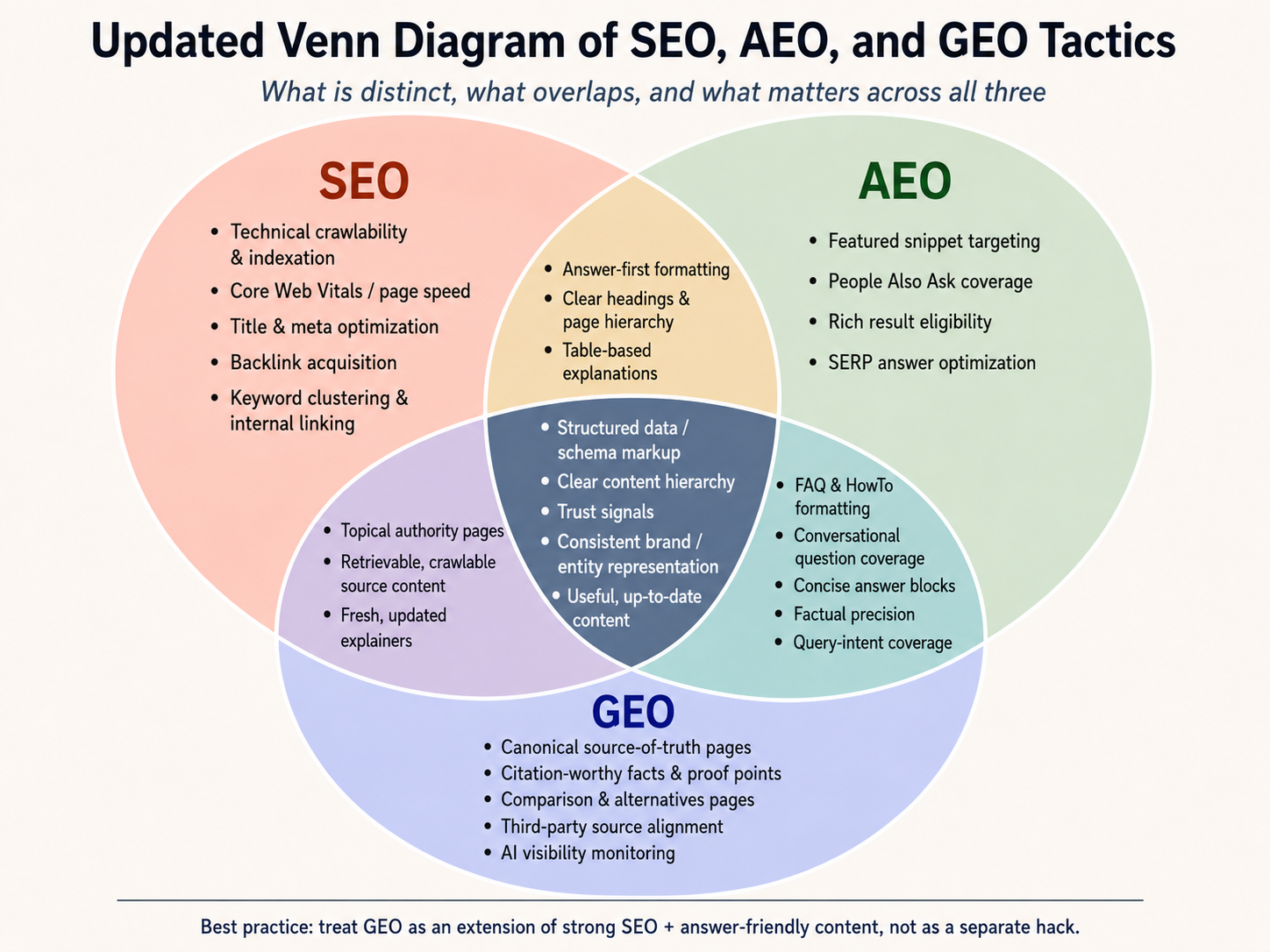
Venn diagram showing the overlap between SEO, AEO, and GEO tactics, including technical SEO, answer-first formatting, schema markup, trust signals, source-of-truth content, FAQs, and AI visibility monitoring.
SEO, AEO, and GEO are not separate strategies. They are three overlapping layers of modern search visibility. SEO helps your content get crawled, indexed, ranked, and discovered in traditional search. AEO helps your content become the clearest answer to a specific question. GEO helps your brand become a trusted source that generative AI platforms can retrieve, summarize, cite, and recommend.
The mistake many brands make is treating GEO as a brand-new discipline that replaces SEO. It does not. GEO works best when it is built on top of strong technical SEO, clear answer-first content, structured information, and consistent brand/entity signals across the web. In other words, if Google cannot understand your site, AI platforms are unlikely to understand it well either.
That is especially important as consumer behavior shifts from traditional search engines to AI answer engines and LLM-powered discovery. People are no longer only searching for “best project management software” or “how to improve credit score.” They are asking AI systems to compare options, recommend vendors, explain tradeoffs, summarize reviews, and identify which brands are most credible for a specific situation. That changes the job of optimization.
What is the difference between SEO, AEO, and GEO?
SEO is search engine optimization. It focuses on making content crawlable, indexable, technically sound, keyword-relevant, authoritative, and competitive in traditional search engine results.
AEO is answer engine optimization. It focuses on structuring content so it directly answers user questions and can appear in featured snippets, People Also Ask results, rich results, and other answer-oriented search surfaces.
GEO is generative engine optimization. It focuses on making a brand, product, or topic easier for AI platforms to understand, retrieve, cite, compare, and recommend in generated answers.
The cleanest way to think about the relationship is this: SEO gets your content found, AEO gets your content answered, and GEO gets your brand represented accurately inside AI-generated responses.
Quick comparison: SEO vs. AEO vs. GEO
Optimization TypePrimary GoalMain SurfaceContent PrioritySuccess SignalSEORank in search resultsGoogle, Bing, traditional SERPsCrawlable, authoritative, keyword-relevant pagesRankings, clicks, organic trafficAEOAnswer specific questionsFeatured snippets, People Also Ask, voice/search answersConcise answers, FAQs, HowTo formatting, structured explanationsSnippet ownership, answer visibility, rich resultsGEOAppear accurately in AI-generated answersChatGPT, Perplexity, Gemini, Claude, AI OverviewsSource-of-truth pages, citations, proof points, entity consistencyAI visibility, citations, recommendations, brand inclusion
SEO, AEO, and GEO are not competing priorities. They are cumulative. A brand that wants to show up in AI answers still needs the fundamentals of search visibility: fast pages, clean technical architecture, indexable content, internal linking, authority signals, and clear metadata.
What SEO tactics still matter?
SEO remains the foundation because most AI visibility still depends on content that can be discovered, crawled, parsed, and trusted. If your website is technically weak, thin, inconsistent, or difficult to understand, generative engines have less reliable source material to work with. That does not mean SEO alone is enough, but it does mean SEO still matters.
The most important SEO tactics include:
Technical crawlability and indexation
Core Web Vitals and page speed
Title tags and meta descriptions
Backlink acquisition
Keyword clustering and internal linking
These are the basics that make your site legible to search engines. They also make your site more usable as a source layer for AI systems, even though GEO requires additional work beyond traditional SEO.
What AEO tactics matter most?
AEO is about making your content useful at the answer level. It is not enough to publish a broad page and hope a search engine or AI model extracts the right point. You need to structure content so the answer is explicit, concise, and easy to quote, summarize, or transform into a direct response.
The most important AEO tactics include:
Featured snippet targeting
People Also Ask coverage
Rich result eligibility
SERP answer optimization
FAQ and HowTo formatting
Conversational question coverage
Concise answer blocks
Factual precision
Query-intent coverage
AEO content should usually include question-based headings, short answer blocks, comparison tables, step-by-step explanations, and FAQ sections. These formats help traditional answer engines, but they also support GEO because generative platforms need clean, structured information to synthesize reliable answers.
What GEO tactics matter most?
GEO is about helping AI platforms understand what your brand does, when you are relevant, why you are credible, and how you compare to alternatives. That requires more than keywords. It requires source-of-truth content, consistent entity representation, citation-worthy proof, and alignment between your owned content and credible third-party sources.
The most important GEO tactics include:
Canonical source-of-truth pages
Citation-worthy facts and proof points
Comparison and alternatives pages
Third-party source alignment
AI visibility monitoring
Topical authority pages
Retrievable, crawlable source content
Fresh, updated explainers
GEO is especially important for brands in categories where buyers ask AI tools for recommendations, comparisons, explanations, and shortlists. If your brand is not clearly represented in the source material that AI systems can access, you may be omitted from the answer even if you have a good product.
What tactics overlap across SEO, AEO, and GEO?
The most important overlap is not a tactic. It is clarity. Search engines, answer engines, and generative engines all reward content that is structured, trustworthy, current, and easy to understand.
The tactics that matter across all three include:
Structured data and schema markup
Clear content hierarchy
Trust signals
Consistent brand and entity representation
Useful, up-to-date content
These are the connective tissue between SEO, AEO, and GEO. Schema helps machines understand what is on the page. Clear hierarchy helps both users and crawlers navigate the information. Trust signals help validate expertise and credibility. Consistent entity representation helps AI systems connect your brand, category, product, leadership, market, and proof points.
Why FAQ and HowTo formatting matter for GEO
FAQ and HowTo formatting are often discussed as AEO tactics, but they also matter for GEO. Generative engines frequently respond to natural-language questions, so content that mirrors how people actually ask questions is easier to retrieve and reuse. A good FAQ section can turn vague topical content into discrete answer units that are easier for AI systems to understand.
That does not mean every page should be stuffed with generic FAQs. The questions should reflect real buyer intent, real category confusion, and real comparison behavior. Strong FAQ content should answer what the product is, who it is for, how it works, how it compares, what proof exists, what limitations matter, and what someone should do next.
For GEO, FAQs are especially useful when they include specific language that connects your brand to the category. For example, a generic answer to “What is generative engine optimization?” may help with AEO. A more useful GEO answer explains how your company approaches GEO, what makes your methodology credible, and what outcomes a brand should monitor.
Why structured data and schema markup matter for GEO
Structured data and schema markup are usually treated as SEO and AEO tactics because they help search engines understand page content and support rich result eligibility. But they also support GEO because they reinforce entity clarity. They help machines understand whether a page is about an organization, service, product, article, FAQ, review, event, person, or local business.
For GEO, schema should not be treated as a magic trick. It is more like a machine-readable confirmation layer. If your visible content says one thing, your schema says another thing, and your third-party profiles say something else, AI systems may struggle to represent your brand accurately.
The best approach is to use schema to reinforce what is already clear on the page. Organization schema, Article schema, FAQ schema, Product or Service schema, Review schema, and Person schema can all help when they are used accurately. The goal is not just rich results. The goal is durable machine understanding.
How to build a practical SEO, AEO, and GEO roadmap
The right roadmap starts with the basics and then moves toward answer visibility and AI representation. Most brands should not start with advanced AI monitoring if their site is not technically crawlable, their content is thin, or their brand positioning is unclear. GEO compounds strong foundations; it does not fix weak ones by itself.
A practical roadmap looks like this:
StageFocusWhat to DoCrawlMake the site technically accessibleFix crawlability, indexation, page speed, metadata, internal linking, and broken content pathsWalkMake content answer-friendlyAdd answer-first formatting, FAQ sections, HowTo content, comparison tables, and query-intent coverageRunMake the brand AI-retrievable and citation-worthyBuild source-of-truth pages, publish proof points, align third-party sources, monitor AI visibility, and update content regularly
This roadmap matters because many brands are skipping directly to the “Run” stage. They want to know how to show up in ChatGPT, Perplexity, Gemini, or AI Overviews, but they have not created the content infrastructure those systems need. The better move is to build a foundation that works across SEO, AEO, and GEO at the same time.
What should a canonical source-of-truth page include?
A canonical source-of-truth page is one of the most important GEO assets a brand can create. It should be the clearest, most authoritative explanation of who the company is, what it does, who it serves, why it is credible, and how it should be categorized. This page should not be vague brand copy. It should be specific enough that an AI system can accurately summarize the company.
A strong source-of-truth page should include:
A clear company description
Category and use-case definitions
Primary products or services
Target customers
Differentiators
Proof points and metrics
Customer examples or case studies
Leadership and expertise signals
Links to credible third-party sources
Updated facts, dates, and claims
This page should be written for humans first, but structured for machines. That means clear headings, concise answer blocks, tables where useful, and consistent terminology. It should also be kept current because outdated information can become a liability in AI-generated answers.
How brands should think about GEO before advertising on ChatGPT
Brands should not think about ChatGPT advertising and GEO as separate initiatives. If a brand is planning to buy ads on ChatGPT or other AI platforms, it should also understand how it appears organically in AI-generated answers. Paid visibility and organic AI visibility will increasingly interact.
That matters because a consumer may see an ad, ask a follow-up question, compare the brand to alternatives, or ask whether the brand is credible. If the underlying AI answer does not understand the brand, omits the brand, or summarizes the category in a way that favors competitors, the paid media investment may underperform.
Before launching ads on ChatGPT, brands should answer several basic GEO questions. Does the brand show up for relevant category prompts? Is the description accurate? Are competitors mentioned more often? Are the cited sources favorable and current? Do third-party sources reinforce the brand’s desired positioning? Are there clear owned pages that AI systems can use as source material?
Common mistakes brands make with SEO, AEO, and GEO
The biggest mistake is treating GEO as a shortcut. Some brands want a quick technical fix that makes them show up in AI answers, but AI visibility is usually the result of content clarity, authority, consistency, and retrievability. There is no durable replacement for being easy to understand and easy to trust.
Another mistake is creating generic FAQ content. FAQs help, but only if they answer real questions with specific, useful, and accurate information. A page full of bland, obvious questions will not meaningfully improve AEO or GEO performance.
A third mistake is ignoring third-party source alignment. Generative engines often rely on information beyond your website. If review sites, directories, partner pages, media coverage, and public profiles describe your company inconsistently, AI systems may struggle to determine what is true.
Best practices for SEO, AEO, and GEO
The best practice is to treat GEO as an extension of strong SEO and answer-friendly content, not as a separate hack. That means every important page should be technically accessible, clearly structured, factually precise, and written in a way that directly answers the questions buyers actually ask.
Brands should also build content around entities, not just keywords. An entity-first strategy clarifies the relationship between the brand, the category, the product, the customer, the use case, the competitors, and the proof points. That is especially important for GEO because AI systems need to understand context, not just match terms.
Finally, brands should monitor AI visibility over time. GEO is not a one-time content project. It is an ongoing visibility discipline that requires tracking how AI platforms describe the brand, which competitors appear, what sources are cited, and where the brand is missing from relevant answers.
FAQ: SEO, AEO, and GEO
What is SEO?
SEO stands for search engine optimization. It is the practice of improving a website so search engines can crawl, index, understand, and rank its content. SEO includes technical optimization, keyword strategy, content development, internal linking, metadata, page speed, and authority building.
What is AEO?
AEO stands for answer engine optimization. It is the practice of structuring content so it directly answers user questions and can appear in answer-oriented search experiences. AEO is especially relevant for featured snippets, People Also Ask results, rich results, voice search, and AI-assisted search interfaces.
What is GEO?
GEO stands for generative engine optimization. It is the practice of improving how a brand, product, or topic appears in AI-generated answers. GEO focuses on source-of-truth content, citation-worthy facts, third-party source alignment, entity consistency, and AI visibility monitoring.
Is GEO replacing SEO?
No. GEO is not replacing SEO. GEO extends SEO into AI-generated discovery environments, but it still depends on many SEO fundamentals, including crawlability, indexation, content quality, site structure, authority, and fresh information.
Is AEO the same as GEO?
No. AEO and GEO overlap, but they are not the same. AEO focuses on becoming the best answer to specific questions, usually in search environments. GEO focuses on being accurately represented, cited, compared, and recommended by generative AI platforms.
Do FAQs help with GEO?
Yes. FAQs can help with GEO because they create clear answer units around natural-language questions. They are most effective when they reflect real user intent, include specific facts, and connect the brand clearly to the category or problem being discussed.
Does schema markup help with GEO?
Yes. Schema markup can help with GEO by reinforcing machine-readable entity clarity. It helps search and AI systems understand the type of content on a page, the organization behind it, and the relationship between entities, products, services, articles, FAQs, and reviews.
What content is most important for GEO?
The most important GEO content includes canonical source-of-truth pages, comparison pages, alternatives pages, topical authority pages, proof-point pages, customer stories, updated explainers, and FAQ content. These assets give AI systems better source material for generated answers.
How do you measure GEO?
GEO can be measured by tracking whether a brand appears in AI-generated answers for relevant prompts, how accurately it is described, which competitors appear alongside it, which sources are cited, and whether the brand is recommended for high-intent use cases. GEO measurement should also track changes over time because AI visibility is dynamic.
What should brands do first?
Brands should start with technical SEO and content clarity. Once the site is crawlable and the core pages are strong, they should add answer-first formatting, FAQs, HowTo content, comparison content, schema markup, and source-of-truth pages. After that, they should monitor AI visibility and update content based on where the brand is missing or misrepresented.
Bottom line
SEO, AEO, and GEO are best understood as overlapping layers of modern search and AI visibility. SEO makes your content discoverable. AEO makes your content answerable. GEO makes your brand retrievable, understandable, and recommendable inside AI-generated experiences.
The brands that win will not be the ones chasing isolated hacks. They will be the ones building clear, crawlable, structured, trustworthy, and frequently updated content ecosystems. That is the foundation for ranking in search, appearing in answers, and showing up accurately when consumers ask AI platforms what to buy, who to trust, and which brands deserve consideration.